Uranus
Uranus is the seventh planet from the Sun and is known for its unique tilt and faint ring system.
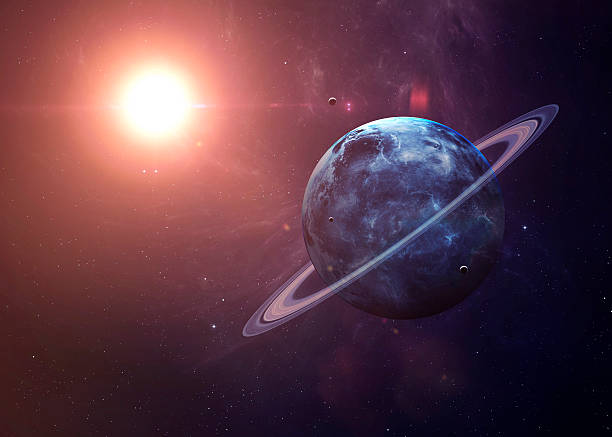
Uranus is the seventh planet from the Sun and is known for its unique tilt and faint ring system.
Uranus is a gas giant with a peculiar feature—it rotates on its side, unlike the other planets in the solar system. This gives the planet an unusual pattern of seasons and an extreme axial tilt. Uranus is the third-largest planet in the solar system and is composed mostly of hydrogen, helium, and water ice.
Uranus has a cold atmosphere, made mostly of hydrogen, helium, and methane. The methane gives the planet its characteristic blue color, as it absorbs red light and reflects blue-green light. The planet experiences extreme temperature variations, with the poles being much colder than the equator.
Uranus has a faint ring system made of dark, narrow rings that are mostly composed of ice and rock. The rings were discovered in 1977 and consist of 13 known rings. These rings are much less prominent than those of Saturn, but they add to Uranus' distinct appearance.
Uranus has 27 known moons, with the five largest being Miranda, Ariel, Umbriel, Titania, and Oberon. These moons are composed primarily of ice and rock. Some moons, like Miranda, show evidence of past geological activity, including large cliffs and valleys, suggesting a history of internal heating.
Uranus has been visited only once by a spacecraft—NASA's Voyager 2, which flew by the planet in 1986. During this encounter, Voyager 2 provided the first close-up images of Uranus and its moons, as well as valuable data about its atmosphere and ring system. The information collected remains the primary source of knowledge about the planet.