Neptune
Neptune, the eighth planet from the Sun, is a gas giant known for its deep blue color and strong winds.
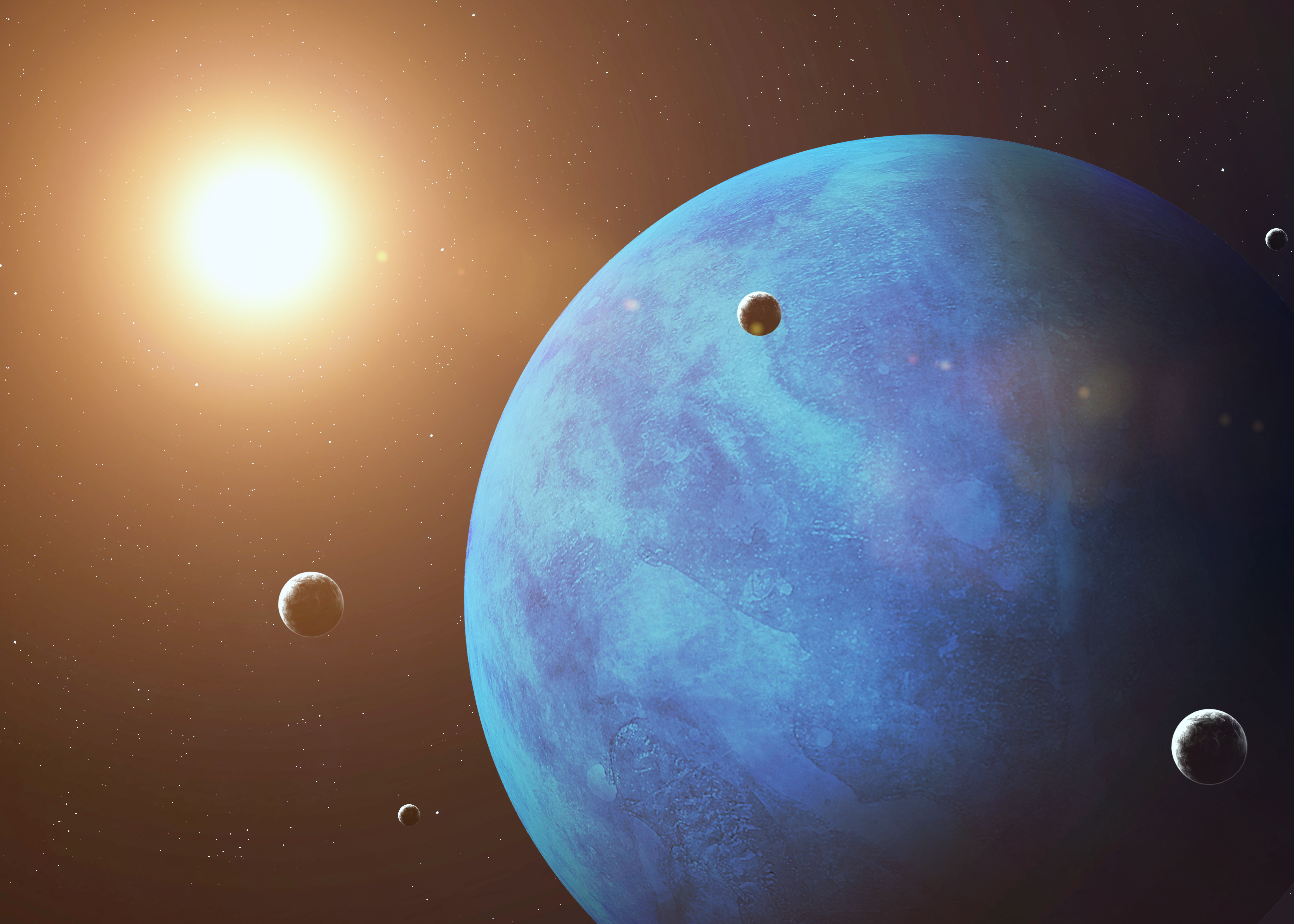
Neptune, the eighth planet from the Sun, is a gas giant known for its deep blue color and strong winds.
Neptune is the most distant planet from the Sun in our solar system, and the only planet discovered through mathematical predictions. Its deep blue color is caused by methane in its atmosphere, and it has strong winds and storms, including the Great Dark Spot, a massive storm system similar to Jupiter's Great Red Spot.
Neptune's atmosphere consists mainly of hydrogen, helium, and methane. The methane gives Neptune its striking blue appearance by absorbing red light and reflecting blue light. The planet experiences extreme weather, including the fastest winds in the solar system, which can reach speeds of up to 2,100 km/h (1,300 mph).
Neptune has 14 known moons, with Triton being the largest and most notable. Triton is unique because it has a retrograde orbit, suggesting it was captured by Neptune's gravity and wasn't originally formed alongside the planet. Triton also has geysers that shoot water vapor and ice into space.
Neptune has a faint ring system composed of dark, narrow rings made up of particles of ice and dust. These rings are not as prominent as those of Saturn, but they are still a significant feature of the planet's system.
Neptune was visited by NASA's Voyager 2 spacecraft in 1989, providing detailed images and data about its atmosphere, moons, and rings. It remains one of the most intriguing planets in the solar system, and future missions may focus on further exploration of its mysterious atmosphere and distant moons.