Jupiter
Jupiter, the largest planet in our solar system, is a gas giant known for its massive size and beautiful Great Red Spot.
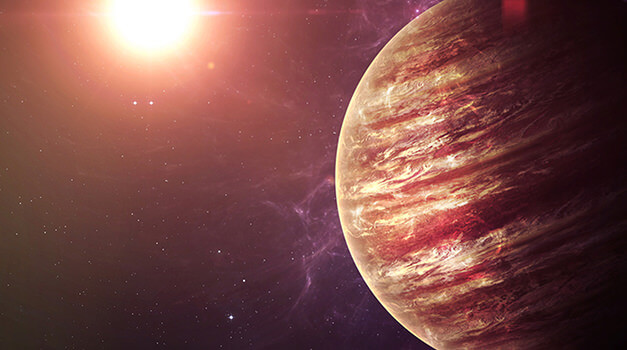
Jupiter, the largest planet in our solar system, is a gas giant known for its massive size and beautiful Great Red Spot.
Jupiter is the fifth planet from the Sun and the largest planet in our solar system. Known for its Great Red Spot and its many moons, Jupiter is a gas giant composed mainly of hydrogen and helium. Its immense gravity plays a crucial role in the solar system, affecting the orbits of other planets and objects.
Jupiter's atmosphere is mostly composed of hydrogen (86%) and helium (13%), with trace amounts of methane, water vapor, ammonia, and other compounds. The famous Great Red Spot is a massive storm that has raged for centuries in the southern hemisphere.
Jupiter has over 80 moons, with four large moons known as the Galilean moons—Io, Europa, Ganymede, and Callisto. These moons are among the largest objects in the solar system outside the Sun and the eight planets.
Jupiter’s weather is extreme, with strong winds and turbulent storm systems. The planet’s Great Red Spot is a massive storm larger than Earth that has been raging for at least 400 years. Jupiter's atmosphere has alternating bands of clouds moving in opposite directions, resulting in powerful jet streams.
Jupiter has been explored by several spacecraft, including NASA's Pioneer, Voyager, Galileo, and Juno missions. Juno, currently orbiting Jupiter, is studying its atmosphere, magnetosphere, and gravitational field, providing valuable data about this gas giant's formation and evolution.